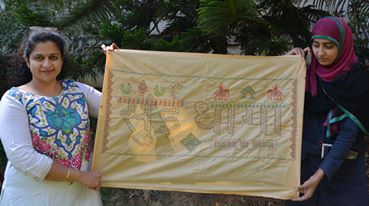
Sui Dhaaga logo designed by us for the promotion of movie “Sui Dhaaga” starring Anushka Sharma and Varun Dhawan , very proud to get this order from Yash Raj films.This logo is designed with Kasuti hand embroidery.
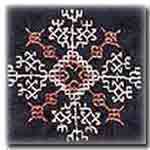
Hubli city & Dharwar city is famous for one type of traditional embroidery called Kasuti.
In Kannada, the word for embroidery is Kasuti . Kasuti or Kashidakari is an antique embroidery form that goes back to the 8th century. Practiced in the villages bordering Karnataka and Maharashtra, particularly in Dharwad, Kasuti work has traditionally been and is still done entirely by women. After a day's hard domestic work, women devote themselves to Kasuti work. The threads of Kasuti embroidery speak of folk craft, its beautiful geometric designs derived from temple sculptures, evoking images of chariots, birds, animals and flowers, all done in the rangoli format. There is a great deal of similarity between Rangoli and Kasooti. There are some differences too. The Rangoli is a free-hand, stationary art-form, whereas Kasuti is predetermined, mobile, and an art-form based on needle and thread
The most frequently used colors are red, purple, orange and yellow, the brighter shades of these being preferred. Kasuti is done on both cotton and silk fabrics. The Kasuti worker does not trace the motifs to set the pattern. The pattern is in the mind and is built upon a net attached to the cloth. For extremely fine materials an embroidery ring is employed to help avoid wrinkles. The basic stitches used are cross and double running stitches. Once a languishing craft, Kasuti slowly became almost tint and owes its revival to few intrepid NGO's and some women craft activities.
A great variety of stitches are employed in order to obtain the desired design. Frequently employed ones are Ele, Mente, Negi, Gavanthe, and Marige. Each thread in the cloth is counted and patterns are stitched in such way that the designs on both sides of the cloth look very much alike. It is the tradition to have a couple of embroidered saris among the bridal trousseau. The pallu (the throw of the sari, which covers the bosom and the head) is very elaborately embroidered. Motifs include geometrical designs, the Gopuram, the kalasha, planted Tulsis, cradles, and chariots. Animals such as elephants, cows, parrots, bulls and peacocks are also used. Sometimes, flowers and creepers are interwoven with the animals.In Maharashtra and Karnataka, very elaborate Kasuti is embroidered on a great variety of articles. Ilkal ( Irkal) saris are well suited for Kasuti work.